Are Service Dogs Allowed Everywhere? If you have a service dog, you’ve probably encountered someone who wasn’t sure whether your dog was allowed inside. Maybe a restaurant host hesitated at the door, or a store employee asked more questions than necessary. Unfortunately, situations like these are fairly common.
Are service dogs allowed everywhere? The short answer is yes, they are allowed almost everywhere.
Under the Americans with Disabilities Act (ADA), service dogs are allowed in most public places where customers, visitors, and members of the public are normally permitted. There are only a few exceptions, along with certain rules handlers need to follow to maintain that access.
Are Service Dogs Allowed Everywhere You Can Go?
Service dogs are generally allowed in public areas of businesses and facilities covered by the ADA. This includes restaurants, grocery stores, hotels, theaters, schools, hospitals, and state or local government buildings.
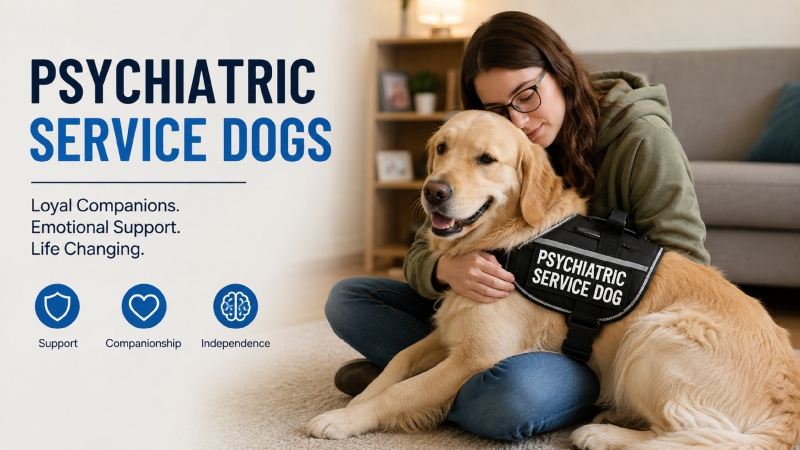
A “no pets” policy normally doesn’t apply because service dogs, including psychiatric service dogs, are working, not visiting as a pet. Food businesses should also allow them in customer areas. Similarly, hospitals usually permit them in patient rooms, clinics, cafeterias, and examination rooms when the public or patients can normally enter.
What About Transportation and Flights?
Service dogs can travel with their handlers on public transportation. This includes buses, subways, trains, taxis, and rideshares.
However, air travel has separate rules. Commercial airlines are covered by the Air Carrier Access Act rather than the ADA. Under federal rules, a service animal is a dog trained to perform tasks for a qualified person with a disability. Airlines may also require certain federal forms before travel.
Handlers should check the airline’s requirements before traveling because flight procedures can be different.
Where Can Service Dogs Be Excluded?
Service dogs are not guaranteed access to every area. A hospital may keep a dog out of an operating room or certain burn units if its presence could affect a sterile environment.
Zoos may restrict service dogs from exhibits where the dog could disturb animals, such as natural predators or prey of dogs. The dog should still be allowed in other areas.
Religious buildings like churches, mosques, temples, and synagogues are generally exempt from the ADA’s public accommodation rules. State or local laws may offer additional protections. That doesn’t mean these organizations will always turn a service dog away. Many welcome them without any issue, but legally, they don’t have to.
At public swimming pools, a service dog can generally stay on the pool deck and in other public areas, but health rules may prohibit the dog from entering the water.
When Can a Service Dog Be Asked to Leave?
A business can ask for a service dog to be removed in limited situations. For example, when the dog is out of control and the handler doesn’t take effective action, or when the dog is not housebroken.
Repeated barking, aggressive behavior, or running around may also become a valid reason for removal. A single bark, however, doesn’t automatically mean the dog is out of control.
Fear of dogs isn’t enough to deny access, and neither are allergies. When possible, a business should try to accommodate both people. If the dog must leave for a valid reason, the person should still have the chance to receive the business’s goods or services without the dog present.
What Can Staff Ask You About Your Service Animal?
If it’s not obvious what a service dog does, staff may ask only two questions: whether the dog is required because of a disability and what task it has been trained to perform.
Staff aren’t allowed to demand medical records, require service dog certification, ask the dog to demonstrate its task, or ask the person to explain their disability.
So, Are Service Dogs Allowed Everywhere?
Service dogs have broad access rights, but those rights are not unlimited. In most public settings, a trained service dog can stay with its handler even when pets are normally banned.
Exceptions usually involve safety, sanitation, the type of service being provided, or a dog that’s not under control. Knowing the rules helps handlers plan ahead and helps businesses make their spaces more accessible while respecting legitimate health and safety limits. Click here.