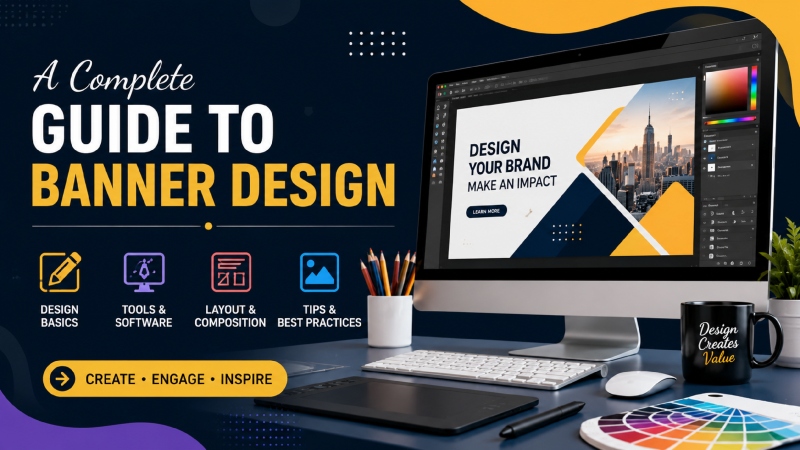
A Complete Guide to Banner Design: Banners are one of the most widely used visual communication tools in digital marketing. From website headers and social media graphics to promotional advertisements and event announcements, banners help businesses, organizations, and individuals share information in a clear and engaging way. A well-designed banner can attract attention, communicate a message within seconds, and encourage users to take the next step.
As online competition continues to grow, visual content has become increasingly important. People often decide within a few moments whether to continue viewing a page or move on. This makes banner design an essential part of modern communication.
What Is a Banner?
A Complete Guide to Banner Design is a visual graphic created to present information, promote a product or service, announce an event, or support branding efforts. Digital banners appear on websites, blogs, social media platforms, email newsletters, online advertisements, and video platforms.
Unlike long-form content, banners are designed to communicate a message quickly. They combine text, images, colors, and layout to make information easy to understand at a glance.
Why Banner Design Matters
Good banner design is about more than appearance. An effective banner helps viewers understand the message immediately while reinforcing a brand’s identity. Businesses use banners to promote seasonal sales, introduce new products, announce special offers, increase brand awareness, and direct visitors toward important actions.
Poorly designed banners can confuse users or fail to capture attention. Clear organization, readable typography, and balanced visuals make a significant difference in how audiences respond.
Common Types of Digital Banners
Website Banners
Website banners often appear at the top of a homepage or landing page. They introduce visitors to the site’s main purpose, highlight featured products, or promote important announcements.
Social Media Banners
Every social media platform uses banner images differently. Profile covers, page headers, and promotional graphics help businesses create a professional and consistent online presence.
Display Advertising Banners
Display banners appear across websites and mobile applications as online advertisements. These banners usually include a concise headline, an attractive image, and a clear call to action.
Email Marketing Banners
Email banners help organize newsletters while drawing attention to featured promotions, announcements, or product launches.
Event and Promotional Banners
Organizations frequently create banners for webinars, conferences, product launches, charity events, educational programs, and community activities.
Elements of an Effective Banner
Clear Headline
The headline should communicate the main message immediately. Short, direct wording is generally easier for readers to understand.
Readable Typography
Choose fonts that remain readable across different screen sizes. Avoid using too many font styles within the same design.
Strong Visual Hierarchy
Important information should stand out first. Headlines, supporting text, images, and calls to action should naturally guide the viewer’s attention.
Appropriate Color Choices
Colors influence both readability and emotion. High contrast between text and background improves visibility, while consistent colors strengthen brand recognition.
High-Quality Images
Images should support the message rather than distract from it. Using sharp, relevant visuals improves the overall appearance of a banner.
Consistent Branding
Businesses should use consistent logos, colors, and typography across all banner designs. This helps audiences recognize the brand more easily.
Banner Sizes and Platform Requirements
Different platforms require different banner dimensions. A banner that works perfectly on a website may not fit a social media profile or advertising platform.
Before creating a banner, it is helpful to check the recommended image size for the intended platform. This prevents stretching, cropping, or loss of image quality.
Planning Before Designing
Effective banners begin with careful planning. Consider questions such as:
- Who is the target audience?
- What action should viewers take?
- Where will the banner appear?
- What information is most important?
- Which colors and images best represent the message?
Answering these questions before designing usually produces a clearer and more effective result.
Choosing the Right Design Tool
Modern design software has made banner creation accessible to beginners and professionals alike. Many platforms provide templates, customizable layouts, and drag-and-drop editing features that simplify the design process. Whether you’re creating graphics for social media, websites, or marketing campaigns, an online banner maker can help organize text, images, and branding elements efficiently while reducing the time required to complete a project.
Common Banner Design Mistakes
Many banners fail because they include too much information. Long paragraphs make banners difficult to read quickly.
Other common mistakes include:
- Using too many colors.
- Choosing unreadable fonts.
- Placing text over busy backgrounds.
- Ignoring mobile devices.
- Using low-resolution images.
- Including multiple competing messages.
Keeping the design clean and focused usually leads to better communication.
Accessibility in Banner Design
Accessible banners are easier for everyone to understand, including people with visual impairments.
Some accessibility recommendations include:
- Maintain sufficient color contrast.
- Use readable font sizes.
- Avoid relying only on color to communicate meaning.
- Keep wording simple and direct.
- Ensure important information remains visible on smaller screens.
These practices improve usability for a wider audience.
Maintaining Brand Consistency
Organizations often create many banners throughout the year. Maintaining consistency helps strengthen brand recognition.
Creating simple design guidelines can make future banner creation easier. These guidelines may include approved colors, typography, logo placement, image style, and spacing.
Consistency builds familiarity and professionalism over time.
Measuring Banner Performance
Publishing a banner is only the first step. Businesses often evaluate performance by tracking:
- Click-through rate
- Website traffic
- User engagement
- Conversion rate
- Time spent on landing pages
These metrics help determine whether a banner successfully communicates its intended message.
Future Trends in Banner Design
A Complete Guide to Banner Design continues to evolve alongside technology. Interactive graphics, responsive layouts, subtle animation, and AI-assisted editing tools are becoming increasingly common.
At the same time, simplicity remains one of the strongest design principles. Clean layouts, readable typography, and meaningful visuals continue to outperform cluttered designs.
Conclusion
A Complete Guide to Banner Design plays an important role in digital communication. Whether the goal is promoting a product, sharing information, or strengthening a brand, a well-designed banner helps audiences understand the message quickly and clearly. By focusing on readability, consistency, accessibility, and thoughtful planning, individuals and organizations can create banners that communicate effectively across websites, social media platforms, email campaigns, and digital advertisements. As design tools continue to improve, creating professional-quality banners has become more accessible than ever, making strong visual communication achievable for users of all skill levels. Visit lwmfhotels. blog for more details.